Skip to content
7Analytica

7Analytica Geopolitical intelligence you can verify

Own the record of what was said.

7Analytica checks news about world events. For any claim it shows where the claim first appeared, which reports only repeated it, and how reliable each source is. It is made for analysts, journalists, researchers and students.

Details: What 7Analytica is

What 7Analytica is

What it is

7Analytica is a geopolitical intelligence platform. It reads news about world events from many outlets, traces each claim back to where it began and scores how well it holds up. It is made for analysts, journalists, researchers, students and anyone who briefs others.

Most coverage hands you a conclusion and leaves the working out of sight. 7Analytica keeps the working: who said what, in which document, at what time, and who else said the same.

How the record is kept

Each item is a dispatch, one news event with a reference number. Each claim inside it links to the reporting it came from. Each score lists its inputs. When a source edits a story, the earlier text is kept. You read the record and reach your own conclusion.

  • Sources linked
  • Inputs shown
  • Edits kept
  • Conclusions left to you

Where to start

Explore 7Analytica

02 Trace

Follow any claim back to where it began.

News stories copy each other. 7Analytica finds the first report of a claim, called its origin, and marks every copy as a repeat. In this sample, eleven reports turn out to come from just four origins.

A sample claim, “The crossing has closed.”, traced through eleven dated reports. The first, from Outlet A at 09:12, is the origin. Outlets C, F and J also have sourcing of their own, so there are four origins. The other seven reports are copies, and each is joined by a line to the origin it copied.

Sample claim“The crossing has closed.”

11Reports

4Origins

Eleven reports, four independent origins.

Details: How a claim is traced, and how a record differs from a feed

How a claim is traced, and how a record differs from a feed

Origins and repeats

Each claim is followed to where it first appeared. A report is an origin when it is the first to publish or has sourcing of its own. A report that only relays another is a repeat. In the sample above, eleven reports come from four independent origins, so the count of corroborating sources is four, not eleven.

Origins are counted apart from reports, which keeps volume from being mistaken for confirmation. Where a primary document exists, it is linked to the claim.

Read a sample investigation or see how scores are built.

An alert feed and a record

Feeds are good at speed. A record is built for the moment someone asks how you know. The two do different jobs.

An alert feed compared with the record 7Analytica keeps, row by row
AspectAn alert feedA record, as 7Analytica keeps it
UnitA headline or a notification.A dispatch with a reference number, split into claims.
RepeatsEach repeat looks like a new confirmation.Repeats are marked, and origins are counted apart from reports.
ScoreA label such as high, medium or low.A number built from five named inputs, each one shown.
EditsThe page is replaced. The earlier text is gone.Each version is captured, compared and kept.
TimeLocal to the publisher, often undated.Your own time zone, written out on every record.
CitingA link that may later say something else.A reference number and a dated capture that do not change.
ConclusionOften supplied for you.Left to you. The record describes the evidence.

03 Zones

See how each region tells the story.

The world’s news is split into eight regions, called zones. Each zone gets a heat reading from 0 to 100 that shows how much it is being covered, so you can see where coverage is loud and where it has gone quiet.

A globe with latitude and longitude lines and coastlines, turning slowly. Reporting is grouped into eight media zones.

8Media zones

Details: Eight media zones, and what a heat reading means

Eight media zones, and what a heat reading means

Zones and heat

7Analytica reads reporting in eight geographic media zones. Each zone has a heat reading from 0 to 100: how much, and how unusually, the zone is being reported on, measured against a 30-day baseline. The inputs are listed with the number. A high reading is a prompt to look, not a conclusion.

A sudden drop in coverage inside an active zone is flagged as well, because a quiet that follows a crisis can be a signal.

What is covered

Geopolitics and borders: events, statements and documents that bear on relations between states and the places where they meet. It is a single, focused subject, kept narrow so that the record can be kept carefully.

Coverage and sources or explore 7Analytica.

04 Audit

Six questions. Each one checked.

Every record is checked on who, what, when, where, why and how. Each question gets its own confidence score, so a strong overall result cannot hide one weak answer. This is called the six-axis audit.

A six-axis audit of a sample record, confidence by axis: Who 78, What 84, When 66, Where 58, Why 41, How 70. The mean is 66. Why is the lowest.

66Mean confidence

Details: How a score is built, and what the six axes are

How a score is built, and what the six axes are

A score is arithmetic you can check

Each input is read on a scale of 0 to 100, multiplied by its weight and added up. The five inputs are source record, independent corroboration, recency, primary documents and framing. Each score shows its inputs, and each input links to the entry behind it.

The score estimates how well the evidence stands at this moment. It is not a verdict that the claim is true.

Change the sample inputs, or read the method.

The six axes

The audit reads one record on who, what, when, where, why and how. Each axis carries its own confidence, so a strong score cannot hide a weak part. When sources disagree on an axis, it is marked as contested instead of picking a side.

Open a sample dossier and audit.

05 Dossier

The finished file you can hand to anyone.

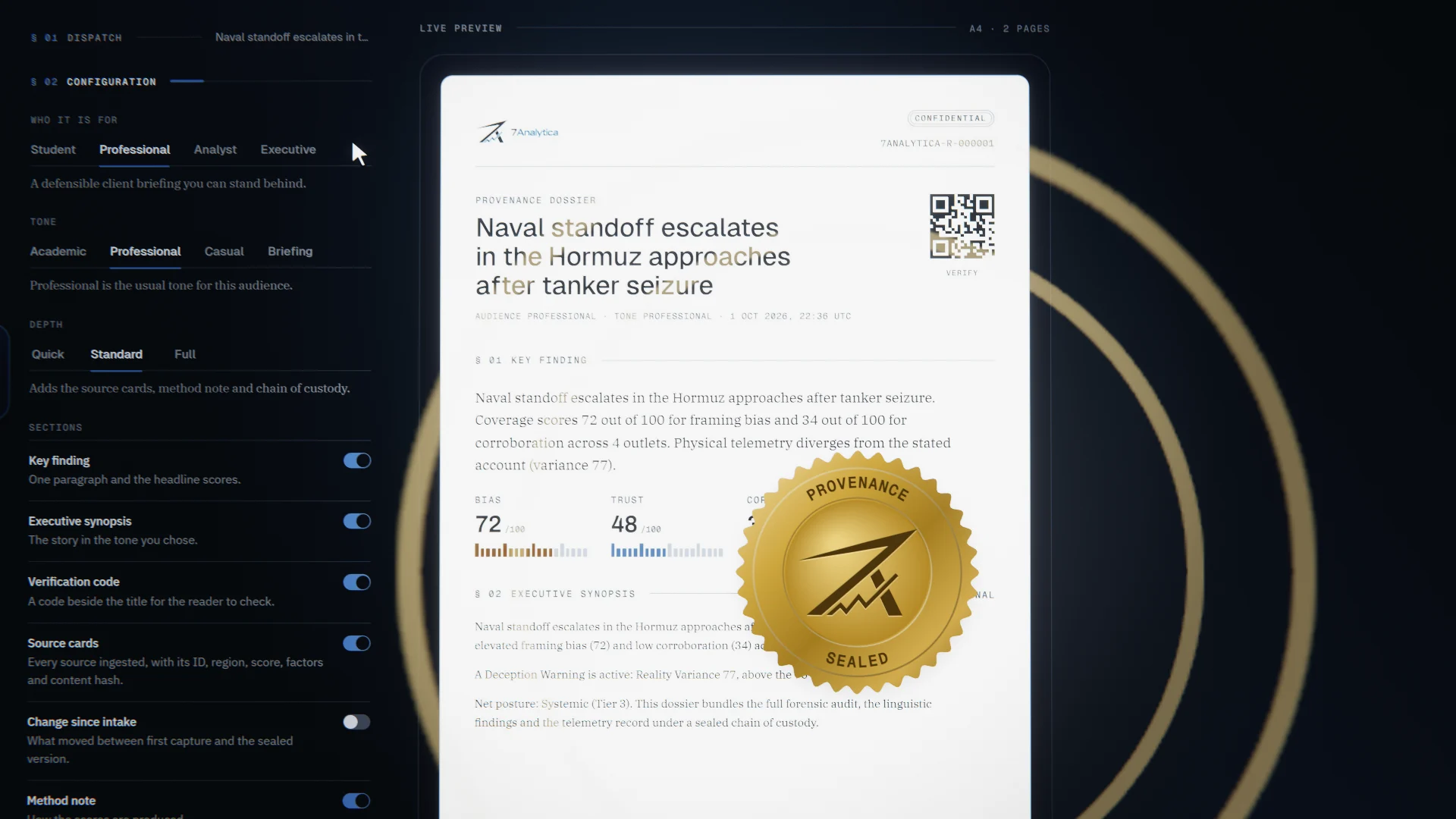
A dossier is the finished file: the claim, where it began, how reliable the sources are, and a seal that fixes it in time. Once sealed, nobody can quietly change it. Any edit becomes a new dated entry.

A sample dossier, the finished file, with four numbered parts. 1, the claim being checked. 2, where it began, with the first report and the copies that followed. 3, how reliable the sources are, as a score with its inputs. 4, sealed and dated: a gold seal fixes the file in time, and any later change becomes a new dated entry.
  1. 1The claimThe statement being checked.
  2. 2Where it beganThe first report, and who copied it.
  3. 3How reliableA score, with the reasons shown.
  4. 4Sealed and datedFixed in time. Edits become new entries.
Details: Dossiers, seals and how the record is protected

Dossiers, seals and how the record is protected

Dossier and seal

A dossier is the structured, exportable record of one story: the claims, the scores and their inputs, the sources and the edit history. Sealing it fixes its content and time. A sealed record is never rewritten. A later change is a new dated entry, so the earlier one stays exactly as it was.

Open a sample dossier or read how records are verified.

Security and provenance

Provenance
Every record has a reference number, a source and a timestamp. Captured pages and their edits are kept.
Scoring
Scores list their inputs. You can see which input moved a score and by how much.
Data handling
Traffic is encrypted in transit and data is encrypted at rest. Passwords are stored only as salted hashes.
Access
Role-based access with least privilege, and multi-factor authentication for administrative access.
Disclosure
Report a vulnerability to the address on the Security page and we read it.

Visit the trust centre.

06 Product

The whole record on one screen.

The news feed, each claim’s trail, the scores and the finished file sit in one workspace. Open any story and every claim links to its source.

A short film with sound (off until you turn it on) of the real 7Analytica app on a floating glass screen: the command centre feed, a record with its provenance and six-axis audit, and a dossier receiving its gold seal, closing on the 7Analytica logo.

Details: What you get on day one, and who it is for

What you get on day one, and who it is for

On day one

  1. The wire. Dispatches from named sources, each with a reference number and a time in your zone.
  2. Scores with their working. Five named inputs behind every score, each linking to the entry behind it.
  3. The forensic record. A source ledger and the edit history, including edits nobody announced.
  4. The World Monitor. Eight zones with a heat reading from 0 to 100 and an access indicator.
  5. A brief you can cite. A dated record with a reference number that does not change after it is sealed.

Who it is for

For anyone who needs to know how a claim is known: analysts, journalists, researchers, students, risk and compliance teams, and anyone who briefs others. Each role has its own workflow, sample entry and result.

See the use cases, explore 7Analytica or see how access is arranged.

07 Who

For anyone who has to explain how they know.

Pick your role to see what 7Analytica does for you.

Details: Who uses it, and for what

Who uses it, and for what

Made for people who brief others

7Analytica is for anyone who has to explain how they know something about world events: analysts, journalists, researchers, students, risk and compliance teams and editors. Each role has its own workflow, a sample entry and a result.

See the use cases.

08 Compare

Same headline. A very different picture.

One claim shows up in eleven places, worded a little differently each time. Left is what you see today. Right is what 7Analytica shows. Illustrative, invented sources.

What you see today

11 places are sharing it

  • Border Post Press Office09:12“Crossing closed until further notice.”Press office
  • Kestrel Wire09:20“The crossing has closed.”Newswire
  • Harbour Courier09:26“Border post shut to traffic.”Newspaper
  • Channel 9 Northvale09:31“Gate is closed, our reporter is at the barrier.”TV, own reporter
  • Radio Meridian09:38“Heard the crossing is closed.”Radio
  • Eastmarch Daily09:44“Crossing closed, officials say.”Regional daily
  • @lena_roadwatch09:47“Stuck at the crossing. Barrier is down.”Social post, on site
  • Valley Drivers Forum09:52“Anyone else hearing it's shut?”Community forum
  • Haulers group chat10:01“Forwarded: crossing closed!!”Messaging channel
  • Northline Notes10:15“The border crossing is now closed.”Blog
  • Southgate Courier10:22“Customs office confirms it is closed to freight.”Regional daily, own call

It looks confirmed. But you cannot tell who said it first, or whether anyone checked.

What 7Analytica shows

4 first reports, 7 copies · earliest 09:12, a press office

  • Border Post Press Office09:12“Crossing closed until further notice.”1st · Press office
  • Kestrel Wire09:20“The crossing has closed.”Copy of #1 · Newswire
  • Harbour Courier09:26“Border post shut to traffic.”Copy of #1 · Newspaper
  • Eastmarch Daily09:44“Crossing closed, officials say.”Copy of #1 · Regional daily
  • Northline Notes10:15“The border crossing is now closed.”Copy of #1 · Blog
  • Channel 9 Northvale09:31“Gate is closed, our reporter is at the barrier.”1st · TV, own reporter
  • Radio Meridian09:38“Heard the crossing is closed.”Copy of #4 · Radio
  • @lena_roadwatch09:47“Stuck at the crossing. Barrier is down.”1st · Social post, on site
  • Valley Drivers Forum09:52“Anyone else hearing it's shut?”Copy of #7 · Community forum
  • Haulers group chat10:01“Forwarded: crossing closed!!”Copy of #7 · Messaging channel
  • Southgate Courier10:22“Customs office confirms it is closed to freight.”1st · Regional daily, own call

At 10:40 the origin text changed from closed to closed for repairs. The old text is kept.

Sample, made up

  1. v1

    The crossing has closed.

    First version
  2. v2

    The crossing has closed for repairs.

    Words added, quietly
  3. v3

    The crossing reopened at noon.

    Meaning reversed

09 Edits

Stories change. The old words stay.

A site can rewrite a story after you read it and say nothing. 7Analytica keeps every version and shows exactly which words moved.

Details: How edits are kept

How edits are kept

Every version is kept

When a news site changes a story, 7Analytica captures each version with the time it was seen, then shows the difference word by word. A change nobody announced is still visible, and the earlier text is still there. The three versions on this page are a made-up sample.

10 Wire

News arrives fast. The record sorts it.

Every report that arrives is tagged as a first report or a copy, so a flood of headlines stops looking like proof.

Sample headlines

  • OriginBorder crossing reopens after talks09:12
  • OriginPort notice issued for shipping lanes09:40
  • RepeatCrossing reopens, officials say09:58
  • OriginSummit text published in full10:21
  • OriginStrait traffic slows overnight10:44
  • RepeatTalks resume, sources say11:03
  • OriginRail link restored after repairs11:25
  • OriginAirspace notice extended11:52
  • RepeatPort notice issued, reports say12:08
  • OriginCeasefire terms circulated12:30
  • OriginSummit text published in full10:21
  • OriginStrait traffic slows overnight10:44
  • RepeatTalks resume, sources say11:03
  • OriginRail link restored after repairs11:25
  • OriginAirspace notice extended11:52
  • RepeatPort notice issued, reports say12:08
  • OriginCeasefire terms circulated12:30
  • OriginBorder crossing reopens after talks09:12
  • OriginPort notice issued for shipping lanes09:40
  • RepeatCrossing reopens, officials say09:58

11 Trust

What we promise, and what we do not.

Every claim links to its source.

Every score shows its inputs.

Every edit is kept.

No verdicts. You decide.

No customer logos or invented numbers.

Single sign-onPlanned

An API and an MCP serverPlanned

Security certificationsPlanned

Details: Security, provenance and what is planned

Security, provenance and what is planned

What is in place

Every record has a reference number, a source and a timestamp. Traffic is encrypted in transit and data is encrypted at rest. Access is role based. We do not claim a certification we do not hold.

Visit the trust centre, read the security overview or see the roadmap.

12 Try it

Pick a headline. See where it started.

These are made-up samples, so nothing here is real news. Choose one and watch 7Analytica follow it back, copy by copy, to the first report.

Sample trace

As you saw it“Border crossing reopens, officials say”

  1. RepeatFour more outlets10:40 to 11:30Each one repeats the news site below.
  2. RepeatNews site10:21Repeats the regional paper.
  3. RepeatRegional paper09:58Quotes the agency statement.
  4. OriginBorder agency statement09:12The first report. A primary document.
Reports
6
Origin
1
Repeats
5

Six reports, one origin. Five of them only repeated.

Details: What the sample shows

What the sample shows

How a trace works

A trace starts from the headline you saw and follows each report back to the one it copied, until it reaches a report that copied nothing. That report is the origin. Everything between the origin and the headline is a repeat.

The three headlines here are made-up samples written for this page. They are not real news, and the times and names are invented for the example.

13 Questions

Questions people ask first.

Short answers, no jargon. There are more on the questions page.

Is 7Analytica a news site?

No. It reads news from other outlets and shows where each claim came from. You still read the stories and make the call.

Does it tell me what is true?

No. It shows the evidence and how strong it is, then leaves the judgement to you. Where something is unsettled, it says so.

Do I need to be an expert?

No. If you can read a news story, you can follow a trace. The words are explained as you go.

What does it cost?

That depends on how many people use it and how. The pricing page explains the options, and a call can sort out the rest.

Details: More questions, answered plainly

More questions, answered plainly

Questions, answered plainly

What is 7Analytica?
A research environment for geopolitical events. It collects reporting from named sources, traces each claim to its origin, scores it with the inputs shown, and keeps a dated record you can cite.
How are scores calculated?
From named inputs: source record, independent corroboration, recency, primary documents and framing. Each score displays its inputs, and each input links to the entry behind it.
What does it cover?
Geopolitics and borders: events, statements and documents that bear on relations between states and the places where they meet. It is a single, focused subject, kept narrow so that the record can be kept carefully.
What happens when a source changes a story?
Each version of a cited page is captured with the time it was seen. The differences are shown word by word and classified, so an unmarked change is visible, and the earlier text is kept.
Where do the reports come from?
From named sources that appear in the source ledger, each with its role: origin, primary document or repeat. The ledger shows how a source is measured, so you can see why it scores as it does.
Can I use it with a team?
Yes. Write to us from the Contact page and say how many people and how you work. The Pricing page describes how access is arranged.
What happens to my notes and searches?
Notes and preferences you create are stored against your account. The Privacy Notice sets out what we collect, why, who sees it and how long we keep it.
Is it certified?
We design our security programme with recognised standards in mind and do not claim a certification we do not hold. The Security page lists what is in place and what is planned.
How do I get access?
Sign up to create an account. If you would like to talk about use by a team, book a call or write to us from the Contact page.

The full list is on the questions page. Not there? Write to us from the Contact page.

14 After you sign up

Three steps from sign up to your first trace.

That is all it takes to start. Want to see it before you sign up? Open the live demo, which uses sample data.

  1. Create your account

    Sign up with your email. We ask you to confirm it before you go in.

  2. Open the wire

    The wire is the stream of new reports. Each one is tagged as a first report or a copy.

  3. Trace your first claim

    Pick any claim and follow it back to where it began. Save the result as a dated file.

15 Start

Check where it came from before you share it.

Sign up to trace your first claim. Sign up creates your account, and we ask you to confirm your email before you go in.

Details: Ways in and what we hold ourselves to

Ways in and what we hold ourselves to

Three ways in

  • Explore as a guest. Open 7Analytica with a guest identity. Nothing to fill in. Explore as a guest
  • Create an account. Your own workspace, saved views and watchlists. Create an account
  • Request team access. Arranged by a person, with roles and shared work. Request team access

Or try the live demo, read the resources or contact us.

What we hold ourselves to

There are no endorsements to quote and no logos to borrow. These are the rules 7Analytica and the company are built on, and you can judge us by them.

  1. Describe, never conclude. We report the state of the evidence. The judgement belongs to the person who has to make it.
  2. Show the inputs. A score without its working is a label. Every score lists what went into it.
  3. Date everything. Each record carries a reference number and a timestamp in a fixed time zone.
  4. Keep the correction. Edits are captured, compared and kept, including the ones nobody announced.
  5. Stay calm. No alarms where the evidence is thin and no reassurance where it is not.

In brief

What is 7Analytica?

7Analytica is a geopolitical intelligence platform that records what was said about world events, where and when. It traces each claim to its source, separates original reports from repeats, scores trust and bias with the inputs shown, and seals a dossier you can cite. It describes the evidence; the conclusion stays with you.

Last reviewed · Read the full FAQ